If you look at the news right now, it feels like the world is spinning faster and faster. Headlines are screaming about U.S. airstrikes in the Middle East, escalating retaliation, and sudden policy shifts on Ukraine. For the average person trying to go about their workday, take care of their family, and pay their bills, the international stage can look terrifying, confusing, and totally disconnected from normal life.
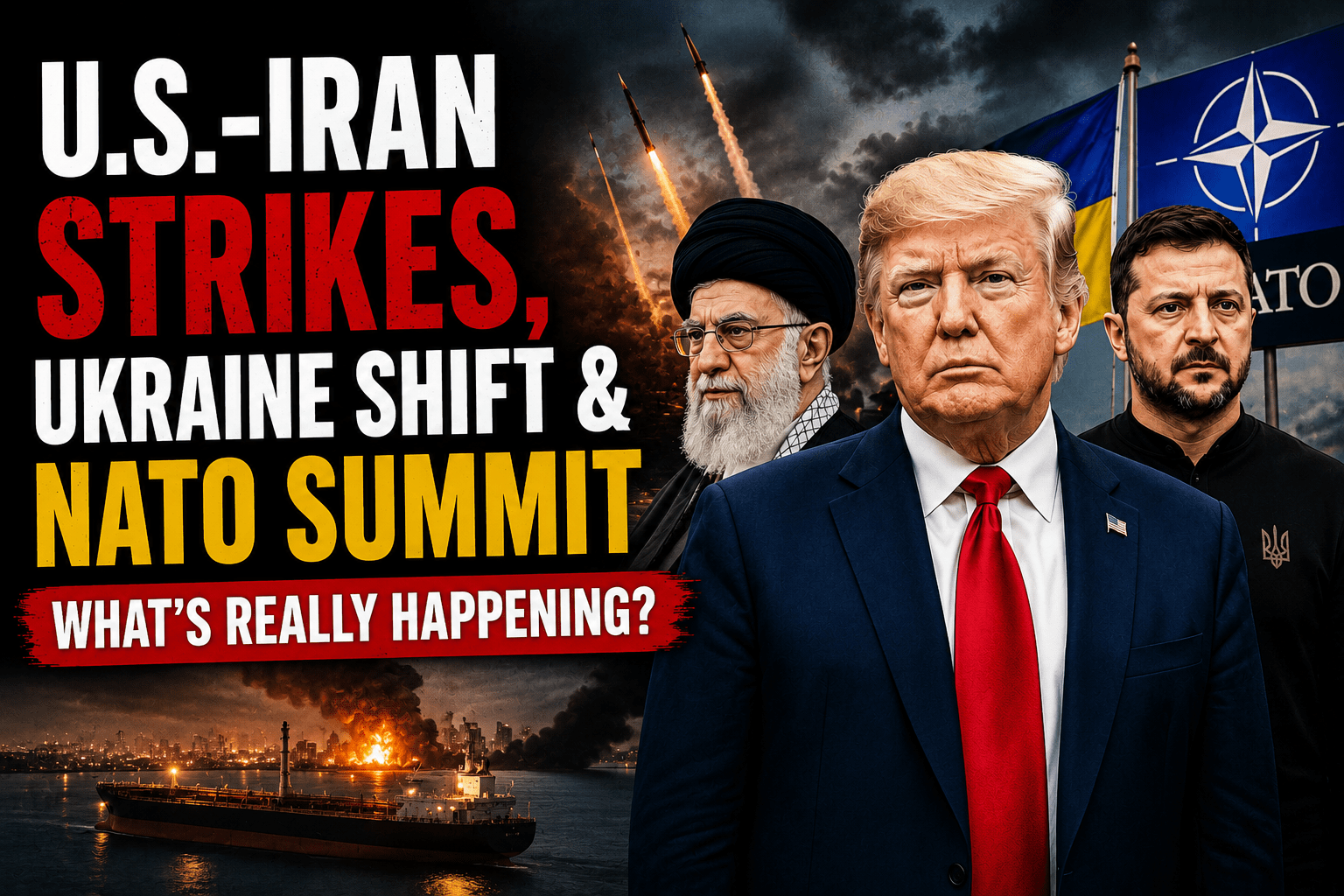
To make sense of the breaking news—specifically the intense military exchanges between the United States and Iran, and the sudden announcements regarding Ukraine at the recent NATO summit—we need to look past the political theater. We need to look at the actual mechanics of how our country’s foreign policy is being run, how the modern presidency operates under pressure, and what these global events mean for you as an American citizen.
The Sudden Flare-Up: Why the U.S. and Iran Are Trading Strikes Again
To understand why U.S. bombs fell on Iran again last night, we have to look back just a few weeks. On June 17, a Memorandum of Understanding (MOU) was signed between the U.S. and Iranian leadership. It was supposed to create a 60-day window of peace to negotiate incredibly complex matters, including regional stability and shipping lanes.
Instead of moving forward, the deal completely imploded.
According to military reports, Iran began trying to assert absolute control over the Strait of Hormuz—the vital, narrow waterway through which roughly 20% of the world’s petroleum passes. They proposed charging transit fees and, more critically, launched multiple attacks on commercial shipping vessels. In one instance, a cargo ship nearly sank, forcing the crew to abandon it.
In response, the administration declared the ceasefire officially over. The military launched two consecutive nights of intense airstrikes, hitting over 90 targets, including drone factories, radar installations, and missile sites near the Strait. In retaliation, Iran fired missiles at U.S. military bases in Kuwait and Bahrain, warning that any further American action would be met with direct force.
The Shifting Rhetoric from the White House
One of the most confusing aspects of this conflict for normal citizens is how quickly the official messaging changes. Just last month, the administration described Iranian leaders as “rational, smart, and strong people” who were ready to make a deal. This week, that narrative flipped entirely, with the executive branch publicly calling those same leaders “scum” and “sick people.”
When you see a leader’s public opinion change so drastically overnight, it usually points to a fundamental shift in strategy. Early on, the goal was to use public flattery to lure Iran to the negotiating table for a massive diplomatic victory. When Iran refused to bend and chose to disrupt the oil lanes instead, the administration pivoted to a strategy of total military dominance, declaring that it is time to “finish the job.”
For everyday Americans, this creates an environment of intense uncertainty. It raises a critical question about how Washington views global conflicts: Can you permanently solve a geopolitical crisis with air power alone, or does heavy bombing simply guarantee a longer, more chaotic war?
The Economic Ripple Effect: The Strait of Hormuz and Your Wallet
It is easy to watch news about the Middle East and think, This is happening thousands of miles away; it doesn’t affect me. But the global economy is deeply interconnected, and this specific conflict hits home faster than almost any other.
Because the Strait of Hormuz is the world’s most critical oil transit chokepoint, any active military conflict there immediately freaks out global energy markets. Following the latest round of strikes, oil prices jumped roughly 7% in a single day.
When global oil prices spike, it creates a chain reaction that hits normal citizens directly:
- Higher Prices at the Pump: Within days of a major conflict in the Strait, gas stations across the United States adjust their prices upward to match the rising cost of crude oil.
- The Cost of Goods: Almost everything you buy at the grocery store or order online is transported by a diesel-powered truck. When fuel costs rise for shipping companies, they pass those costs down to the consumer, fueling domestic inflation.
- The Midterm Factor: All of this is happening as the country barrels toward the critical November midterm elections. Economic anxiety, driven by spiking energy costs, is historically the number one issue that decides which party controls Congress. Washington knows this, which is why the administration is under immense pressure to either completely crush the Iranian threat or force a rapid ceasefire before gas prices damage their party’s chances at the ballot box.
The Patriot Missile Announcement: A Surprising Pivot on Ukraine
While dealing with the active shooting war with Iran, the administration also made headlines at the NATO summit in Turkey by announcing a massive policy shift regarding Ukraine. The U.S. announced it would grant Kyiv a license to locally manufacture Patriot air defense systems.
On the surface, this looks like an incredibly generous and benevolent move to support our European allies. Ukraine has been running dangerously low on interceptor missiles as Russia intensifies its strikes on civilian infrastructure. Granting them the license to build their own systems appears to solve two problems at once: it gives Ukraine the tools they desperately need, and it satisfies the political demand that “America shouldn’t just hand out free weapons forever—they should make them themselves.”
The Gap Between Politics and Reality
However, when you look past the announcement, you find a massive gap between political rhetoric and practical engineering.
National security experts and defense contractors quickly pointed out that U.S. defense companies hadn’t even been informed of this deal before it was announced. Furthermore, a Patriot missile system is one of the most highly sophisticated, technologically dense pieces of military hardware on earth. It requires specialized manufacturing plants, rare raw materials, and precision engineering that took the United States decades to perfect.
Experts estimate it could take years—not months—before Ukraine has the actual capability to manufacture functional Patriot interceptors on their own. In the short term, the announcement serves as a useful political talking point to show “unity” at a NATO summit, but it does very little to solve the immediate shortage of missiles on the ground today.
The Global Interceptor Shortage and the Defense Budget
This brings us to a much larger, systemic issue that normal citizens rarely hear about: the world is facing a severe shortage of defensive missiles.
Because Washington chose to engage in an active military conflict with Iran, the United States and its regional allies (like Saudi Arabia, the U.A.E., and Qatar) are rapidly burning through their stockpiles of interceptor missiles to defend against Iranian drones and rockets. At the same time, Ukraine is burning through the exact same types of missiles to defend against Russia.
Our defense manufacturing base simply cannot keep up with the demand. This shortage has driven the U.S. military budget to an astronomical $1.5 trillion request.
Vanity Projects vs. Modern Warfare
When a country spends $1.5 trillion on defense, a normal citizen would assume that money is going toward the most cutting-edge, efficient tools available. However, a significant portion of that budget is being allocated to traditional, massive weapon systems—such as proposed “Trump-class” nuclear-powered battleships.
If you watch how modern wars are actually being fought in Ukraine and the Middle East, the landscape has completely changed. Wars are no longer won by giant, multi-billion-dollar battleships. They are being fought—and won—using cheap, mass-produced drones and affordable, rapid-fire interceptors. Ukraine has managed to neutralize massive portions of the Russian navy using tiny, remote-controlled sea drones. Iran has disrupted global shipping using cheap, off-the-shelf drone technology.
Yet, Washington’s budget priorities remain heavily focused on expensive, old-school weapon systems that double as political vanity projects. This creates a dangerous disconnect: we are spending record amounts of taxpayer money, but we are not necessarily building the agile, modern military required to face 21st-century threats.
The Air Force One Security Scurry
Perhaps the most surreal and revealing moment of the entire week involved the presidency’s actual aircraft. The administration recently accepted a newly upgraded, luxury jet—essentially a heavily customized aircraft from Qatar—and flew it to the NATO summit in Turkey to show it off to world leaders.
However, when the summit ended, the President did not fly that new plane back home to the United States. Instead, they had to fly a standard, older Air Force One aircraft from Turkey to the United Kingdom, before finally switching back to the new jet for the final leg of the journey.
Why the sudden logistics nightmare? Because the Secret Service intervened.
As soon as the active military strikes against Iran began, security officials realized that the new, luxury jet lacked the highly sophisticated, secure military communication systems required to command an active war from the sky. Furthermore, it lacked the advanced anti-missile defense systems—such as automatic flare and chaff dispensers—built into the traditional Air Force One.
This incident is a perfect metaphor for how modern Washington often operates: prioritizing a flashy, expensive “paint job” for the cameras, only to realize under actual pressure that the underlying, boring infrastructure of security and expertise was completely missing.