WASHINGTON — There is a long-standing axiom in political psychology that a leader’s physical surroundings eventually reflect their internal state. If that is true, the current state of the executive branch should deeply concern every American.
While global markets reel from spiking oil prices, the Strait of Hormuz remains largely blocked, and American service members navigate a highly volatile, active conflict with Iran, the view inside the Oval Office reveals a starkly different set of priorities.
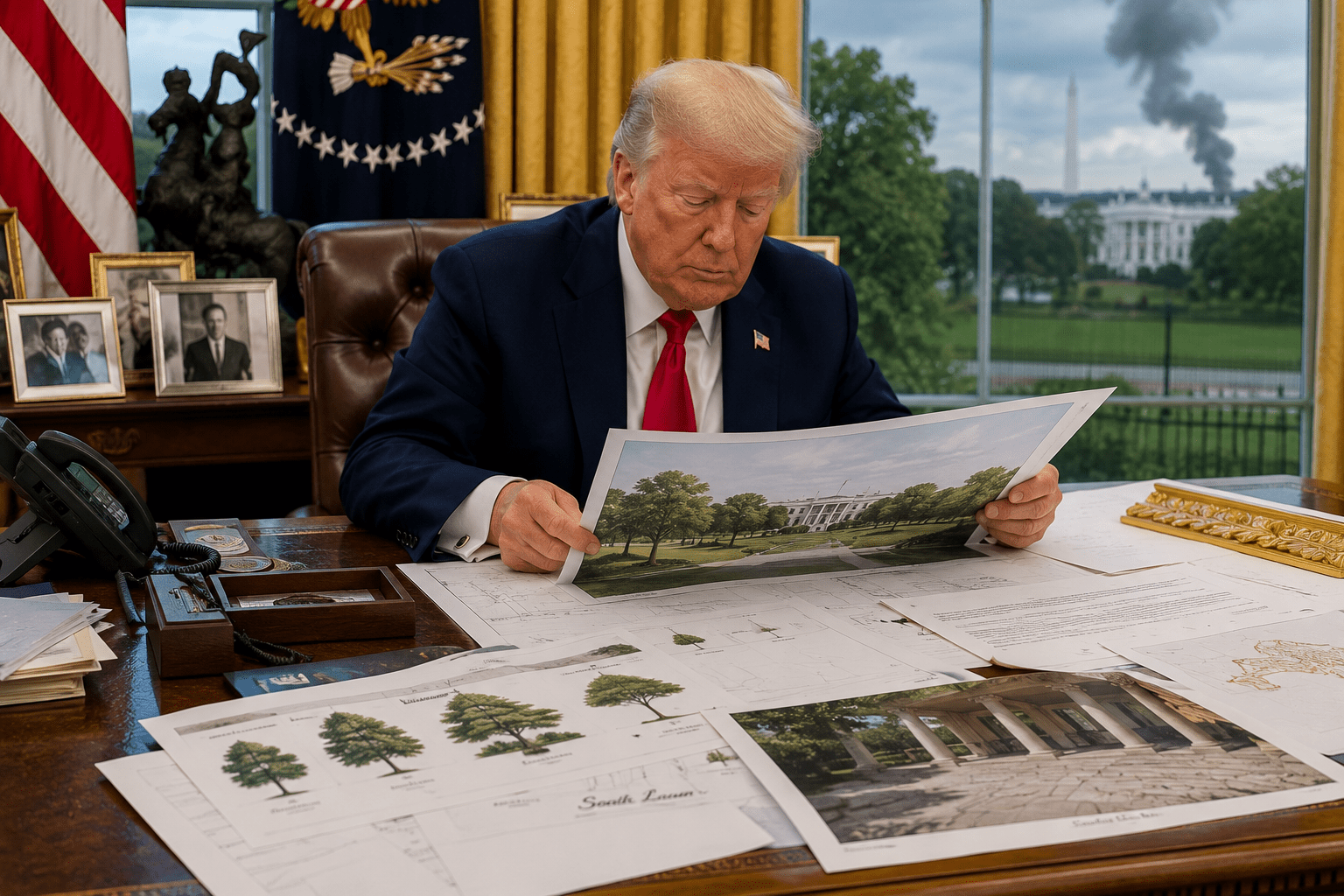
According to explosive new reporting from investigative journalists Maggie Haberman and Jonathan Swan in their book Regime Change: Inside the Imperial Presidency of Donald Trump, the Resolute Desk has not been covered with theater maps, intelligence briefs, or economic recovery plans. Instead, it has been covered with landscaping printouts.
“I’m ordering trees for the White House,” Donald Trump reportedly told the journalists during an interview conducted amid the opening weeks of the conflict. “I know how to buy good trees. Maples.”
The revelation of a presidency deeply preoccupied with cosmetic “Trumpification” projects while major national security crises mount has triggered a massive, defensive reaction from the West Wing. It exposes a deeply insular executive culture operating on pure instinct, completely detached from the grinding realities of governance.
Architectural Obsessions and the Superglue Presidency
The details emerging from Haberman and Swan’s reporting paint a vivid, at times surreal portrait of an “Imperial Presidency” dominated by aesthetic fixations. Sources within the administration describe a commander-in-chief who dedicates a massive portion of his working day to personal architectural oversight, frequently interrupting critical state business to micro-manage renovations.
In one extraordinary sequence detailed by Swan, several senior national security aides were gathered in the Oval Office for a highly classified defense briefing regarding foreign threats. The critical session was abruptly disrupted when a tradesman walked directly into the room carrying stone samples for a patio expansion project in the Rose Garden. Rather than dismissing the interruption, Trump paused the national security briefing to inspect the masonry.
This obsession with physical legacy extends down to the smallest decorative details. Press Secretary Karoline Leavitt reportedly walked into the Oval Office early in the term to find the President personally applying a gold applique onto the fireplace using superglue.
On a grander scale, Trump has focused immense energy on constructing a massive, Roman-and-Athenian-inspired grand ballroom on the White House grounds. Advisers note he boasted with immense satisfaction that the project’s perimeter columns would be structurally larger than those supporting the United States Supreme Court.
The Walter Reed Rebuttals and the Health Question
The public disclosure of these profound workplace distractions triggered an immediate, late-night tirade from Trump on Truth Social. While the post explicitly targeted Haberman and Swan—relying on familiar, highly personal insults—it also contained an unexpected, unprompted defense of his physical and cognitive health.
“I just finished a perfect physical at Walter Reed,” Trump wrote, claiming he undergoes the comprehensive medical evaluation every six months. He added, “And I requested another Cognitive Test… And I aced them all — Got every question right.”
TRUTH SOCIAL BULLETIN // EXECUTIVE BRIEF
-----------------------------------------------------------
[STATUS]: Alleged "Perfect" Physical & Cognitive Screening
[LOCATION]: Walter Reed National Military Medical Center
[FREQUENCY CLAIM]: Every 6 Months (Contradicts standard protocol)
-----------------------------------------------------------
OBSERVATION: Unprompted medical defenses historically signal
acute sensitivity to reporting regarding executive stamina.
The decision to explicitly highlight an emergency medical visit from months prior raised immediate red flags across Washington. Independent reporting indicates that the hospital visit in question was far from a routine, semi-annual checkup. It required the sudden assembly of 22 distinct medical specialists—a footprint consistent with an urgent diagnostic intervention rather than standard preventive care.
By aggressively rehashing the medical visit to counter reports of his workplace distractions, Trump inadvertently redirected the national conversation back to a topic he intensely dislikes: his own physical stamina and age.
The Anatomy of an Insulated Second Term
For political analysts, the most chilling aspect of the Haberman-Swan reporting is not the preoccupation with maple trees or gold leaf, but the total breakdown of the traditional guardrails that govern the modern presidency.
In his first term, Trump’s most volatile instincts were frequently checked, delayed, or managed by a rotating cast of traditional conservative advisers, military generals, and career civil servants. In his current term, those institutional shocks have been thoroughly dismantled. Trump is operating entirely on pure gut instinct, largely insulated from consequences.
Several key factors have created this profound moral hazard:
- Term Limits: Lacking the electoral pressure of a future re-election campaign, traditional polling data holds almost no sway over executive decision-making.
- Judicial Immunity: Following sweeping Supreme Court rulings clarifying presidential immunity, the historical fear of post-presidency legal exposure has evaporated.
- Appointee Purity: Career experts willing to deliver unpleasant briefings have been replaced by a monoculture of absolute loyalty, meaning the President is rarely forced to confront objective, harsh realities.
This insulation has fostered a dangerous environment where breathtaking national security risks—such as initiating an open conflict with a major regional power—can be launched with minimal institutional planning.
The Bracing Reality of Public Opinion
While the West Wing remains entirely focused on architectural legacies and TikTok engagement metrics—with Trump reportedly showcasing printouts bragging about 339 billion views on the platform—the rest of the country is experiencing a vastly different reality.
Internal data compiled by the campaign’s own chief pollster, Tony Fabrizio, reveals a stark disconnect between the White House’s self-image and the voter base. Bracing focus groups conducted across critical demographics indicate that the ongoing military action in the Middle East is profoundly unpopular, poorly understood by the electorate, and widely viewed as a direct violation of previous anti-interventionist campaign promises.
Furthermore, voters consistently voice intense anxiety over the downstream economic consequences of the conflict, which has sent global energy markets into a tailspin, severely exacerbating the domestic affordability crisis.
CAMPAIGN FOCUS GROUP SUMMARY (FABRIZIO RESEARCH)
===========================================================
Primary Concern: Affordability & Downstream Inflation
War Status: Deeply Unpopular / Seen as Distraction from Economy
Key Vulnerability: High perception of rule-breaking behavior
===========================================================
The Permanent Imprint
Donald Trump has often viewed the presidency through the lens of a real estate developer, treating the symbols of American democracy as properties to be updated, branded, and claimed. The current frantic push to alter the physical layout of the White House—the grand Roman columns, the imported maple trees, the gold-leaf accents—is part of an explicit effort to leave a permanent, visible imprint on the capital.
But as history repeatedly demonstrates, a nation’s strength is never measured by the diameter of its marble columns. While the President stands in the Oval Office admiring landscape renderings, the actual machinery of American foreign policy and economic stability sits unattended. In an era of supreme global volatility, a government operating on pure gut instinct and gold-leaf distractions is a luxury the American public can ill afford.