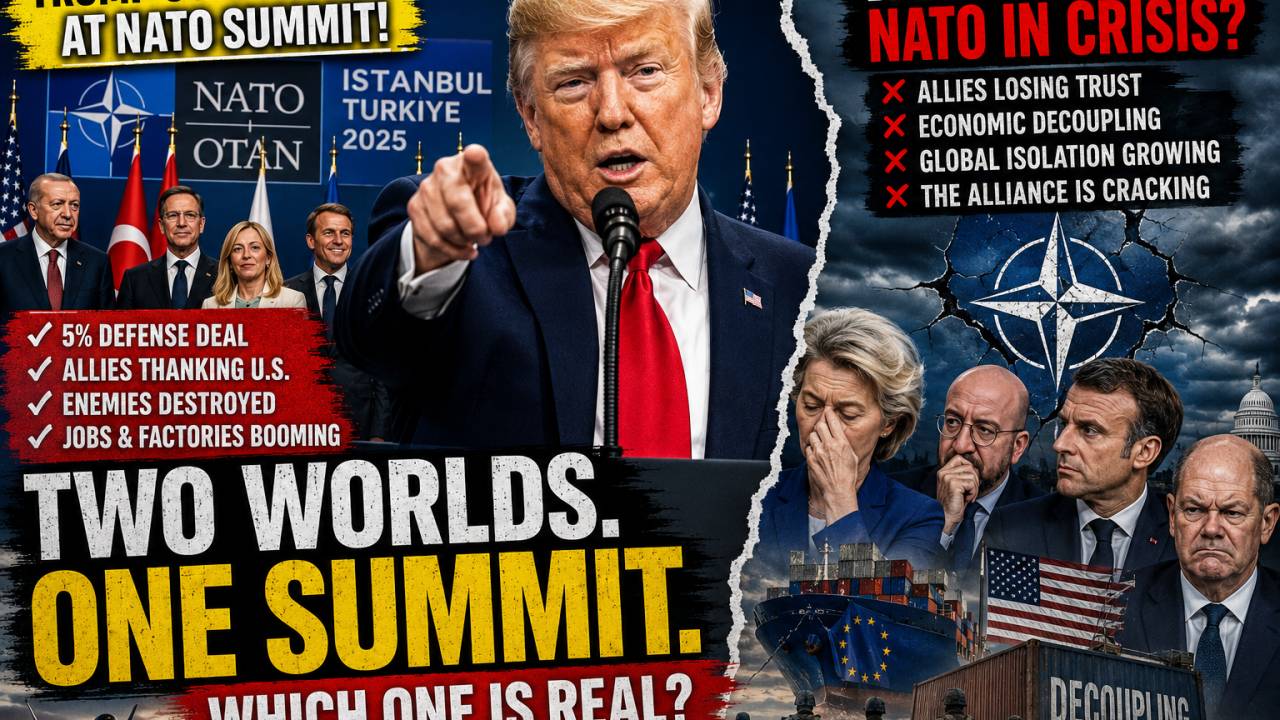
If you happened to watch President Trump’s recent press conference streaming live from the NATO summit in Turkey, you might feel like you are experiencing severe political whiplash.
Depending on which news channel you flip to, or which social media feed you scroll through, you are being presented with two completely parallel universes. In one universe—the one broadcast directly from the President’s podium—the United States has just concluded the most successful summit in world history, our military has single-handedly dismantled our enemies in a matter of weeks, global leaders are weeping with “love and respect” for American leadership, and manufacturing plants are sprouting up across the American heartland like wildflowers.
In the other universe—the one occupied by foreign intelligence agencies, veteran diplomats, and international journalists—the Transatlantic Alliance is in a state of terminal collapse, our oldest allies are actively decoupling their economies from ours, and the hyperbole coming from the podium is masking an incredibly volatile and dangerous global reality.
Now, I’m going to step out of the partisan echo chambers. We aren’t here to blindly cheer, and we aren’t here to reflexively outrage. As we analyze this moment, our goal is to treat this text exactly like a historical document. We are going to break down the specific claims made in that press conference, cross-reference them with actual geopolitical facts, and explain the deep, systemic shifts currently happening to our country’s standing on the world stage.
The Linguistic Currency of “Love and Respect”
Let’s begin where the President began: the optics of the summit itself. Throughout the press conference, the President repeatedly emphasized the intense “love,” “unity,” and “respect” in the room among the world leaders, claiming that while foreign nations used to “laugh at us” two years ago, they are now universally thanking the United States.
In the realm of political commentary, this specific rhetorical style is what we call personalist diplomacy. It is a worldview that filters massive, complex international relations entirely through the lens of personal relationships and ego. For this administration, an alliance is not functioning because of treaties, shared democratic values, or institutional agreements; it is functioning if the individual leaders tell the President, “Sir, we love you.”
But if you look past the hyperbole, the choice of whom the President praised tells us everything we need to know about where American foreign policy is swerving.
The most glowing praise of the evening was reserved for Turkish President Recep Tayyip Erdogan. The President called him a “great man,” a “strong leader,” and a “friend,” even commending him for running Turkey like a successful “company.”
To a veteran observer of geopolitics, this is a profound statement. Turkey is indeed a vital NATO member, possessing the second-largest standing military in the alliance. But Erdogan is also a deeply authoritarian leader who has systematically hollowed out Turkey’s democratic institutions, jailed journalists, and frequently played both sides of the fence between NATO and Russia. By praising an autocrat for running a country like a “company,” the administration is signaling a preference for centralized, authoritarian efficiency over the messy, slow-moving processes of traditional Western democracies.
Even more startling was the President’s offhand praise for Syrian President Bashar al-Assad, claiming he is doing an “unbelievable job in unifying Syria.”
Let’s ground this in historical reality: Assad is a dictator who has spent the last decade waging a brutal civil war against his own people, utilizing chemical weapons on civilian populations, and relying entirely on Russian and Iranian military intervention to keep his regime alive. For an American President to praise Assad on the world stage is an absolute, unprecedented departure from seventy years of American foreign policy consensus. It signals to the rest of the world that the United States has completely abandoned “human rights” or “democracy” as foundational principles of its global alignment, replacing them entirely with a transactional respect for raw, authoritarian survival.
The Math and Myth of the 5% Defense Benchmark
The centerpiece of the President’s economic and military narrative was the announcement that NATO allies have agreed to raise their annual defense spending benchmark from 2% of their GDP to an unprecedented 5%. The President framed this as a personal victory, claiming that European nations are now “thanking him” and pouring billions of dollars directly into American defense contractors like Lockheed Martin, Northrop Grumman, and Boeing.
Let’s look at the substance of this claim. It is absolutely true that the United States has historically borne an unfair share of the financial burden for defending Europe. For decades, American presidents from both parties have begged European nations to meet their 2% defense targets. When this administration uses aggressive, transactional rhetoric to force Europe to pay more for its own security, it is actually hitting a chord that resonates with millions of everyday Americans who are tired of funding global defense while domestic infrastructure crumbles.
But the jump to a 5% GDP target is where the narrative collides with economic reality.
To put that number in perspective, the United States—the most heavily militarized nation on Earth—spends roughly 3.4% of its GDP on defense. For European social democracies like Germany, France, or Italy to suddenly skyrocket their defense spending to 5% would require them to completely dismantle their welfare states, slash healthcare, gut education, and completely restructure their domestic economies.
So, what is actually happening behind the scenes?
As we learned from the explosive Wall Street Journal reporting discussed earlier this week, Europe is dramatically increasing its defense spending—but they aren’t doing it out of “love” or gratitude for American leadership. They are doing it out of sheer panic.
European leaders have looked at the unpredictability of Washington, the secret phone calls with Putin, and the erratic demands over territories like Greenland, and they have concluded that the American security umbrella is permanently broken. They are boosting their defense budgets because they realize they might have to fight a war against aggression completely alone.
Furthermore, while the President claimed this money is being spent on “American-made equipment Made in the USA,” European nations are actually accelerating plans to build their own domestic defense supply chains. They are trying to decouple from American defense juggernauts precisely because they fear that a future American administration might abruptly cut off their supply of parts or ammunition during a crisis. The short-term boom for US defense contractors masks a long-term, catastrophic loss of American economic dominance in the European market.
The “Decimated” Iran Conflict and the Threat of Article 5
The most volatile segment of the press conference involved the reignited conflict with Iran. The President declared the military operation a “tremendous success,” claiming that the United States had completely demolished Iran’s combat capability in a matter of weeks—sinking 159 ships to the “bottom of the sea,” destroying their air force on the runways, and permanently trapping their nuclear ambitions under a collapsed granite mountain.
When a journalist from the New York Times pushed back, pointing out that just last month the President had called Iranian leaders “rational, smart people,” the President responded with stunning candor: “I got to know them… and I’m not sure I want to make a deal with them. I’ll just finish the job.” He later added that if Iran strikes back, the US will hit them “10 times harder,” and openly admitted, “We might hit them tonight.”
This language is designed to project absolute, terrifying deterrence. And against a regional adversary like Iran, American conventional military dominance is so overwhelming that the administration can indeed inflict catastrophic damage in a short window.
But let’s look at the strategic trap this creates for the United States.
During the press conference, the President openly complained that allies like Spain, Italy, and the United Kingdom “were not there for the US” during this conflict, mocking the British response as “not in the spirit of Winston Churchill.” He then issued a veiled warning, suggesting that if those European nations are ever attacked, the United States might not be there for them.
This brings us right back to the ultimate vulnerability we discussed a few days ago: NATO’s Article 5.
The entire foundation of Western global stability relies on the absolute, unquestioned certainty that if a NATO member is attacked, every other member will immediately go to war to defend them. The moment an American President stands at a podium and suggests that our commitment to defend our allies is conditional—based on whether they helped us in a separate, unprovoked conflict in the Middle East—the deterrent power of NATO evaporates.
When you tell the world that American security commitments are transactional, you are inviting our primary adversaries, Russia and China, to test the boundaries. If Vladimir Putin believes that the United States will not honor Article 5 because Spain or Latvia didn’t send ships to the Persian Gulf, the temptation to launch a limited military incursion into Eastern Europe becomes almost irresistible. By using the press conference to air personal grievances against our allies, the President is making the world infinitely more dangerous, increases the likelihood of a major global miscalculation, and puts American service members in direct jeopardy.
The $19 Trillion Tariff Narrative
On the domestic front, the President used the global stage to tout massive economic achievements, claiming that his aggressive tariff policies have forced a historic $19.2 trillion investment into American manufacturing plants, car factories, and AI infrastructure. He specifically highlighted a major announcement that Toyota is leaving Mexico to build the largest car manufacturing plant in the world in Texas, purely to avoid a 25% American tariff.
To an audience of American workers who have watched decades of deindustrialization hollow out their towns, this narrative is incredibly seductive. The idea that we can simply use the economic might of the American market to bully foreign corporations into bringing jobs back to Texas, Oklahoma, or Ohio is a powerful political message.
But as a professor of political economy, I am obligated to urge you to look at the actual numbers. The entire Gross Domestic Product (GDP) of the United States is roughly $28 trillion. The claim that $19.2 trillion—an amount nearly equal to two-thirds of the entire American economy—has been invested in corporate manufacturing plants in a single year is statistically impossible.
Tariffs can indeed force specific corporate adjustments, like a single car plant moving across a border. But tariffs are also a double-edged sword. They function as a consumption tax paid directly by American consumers. When we impose 100% to 250% tariffs on microchips, steel, aluminum, and pharmaceuticals, the foreign companies do not absorb that cost; they pass it directly to you at the cash register.
Furthermore, by forcing industries like AI to build their own independent electric grids because our current national infrastructure cannot handle the power load, we aren’t innovating; we are fracturing our own domestic energy sector. The narrative of hyper-growth cloaks a highly volatile economic environment marked by soaring inflation, disrupted global supply chains, and an increasingly isolated American market.
The Domestic Enemy: The Rhetoric of “Communism”
Finally, we have to look at the domestic political weaponization of this international press conference. When asked by a reporter from the Epoch Times about his message to people living under democracies, the President pivoted entirely away from foreign policy to attack his domestic political opponents at home.
He declared that a dangerous form of “communism” is currently forming inside the United States. He labeled his political rivals as “lowlifes,” “lunatics,” and “communists” who “don’t want God” and want Americans to “die in squalor.” He even went so far as to state that the United States is currently in more danger from these internal political forces than it was during World War I, World War II, Pearl Harbor, or the terrorist attacks of September 11th.
This is arguably the most critical takeaway from the entire press conference. Traditional American statesmanship dictates that “politics stops at the water’s edge.” When a President stands on foreign soil at an international security summit, they are supposed to represent the entire United States, projecting unified national resolve to our friends and foes alike.
By using a NATO summit podium to declare that half of the American population is worse than the Axis powers or Al-Qaeda, the President is broadcasting our ultimate weakness to the world. He is telling Vladimir Putin, Xi Jinping, and every authoritarian reading the transcript that America is so deeply divided, so consumed by internal hatred, and so politically unstable that we are incapable of sustained, long-term global leadership.
The Core Takeaway
When we sit back and analyze this entire press conference, the conclusion we reach is profound. This event was not designed to conduct actual international diplomacy. It was a highly produced, reality-television campaign rally broadcast from a foreign capital.
The assertions of absolute military dominance over Iran, the statistically fabricated economic figures, the demands for a mathematically impossible 5% NATO spending target, and the bitter attacks on domestic political rivals are all part of a single narrative architecture designed for an audience back home. It is designed to make the American voter feel a false sense of security, wrapped in the illusion of global dominance.
But the world is not watching a reality show. Our allies are reading the fine print, looking at the structural volatility, and quietly walking away from the table.
As American citizens, we have to realize that true national strength cannot be sustained by hyperbole and personalist diplomacy. If we continue to treat global security, vital international alliances, and the rule of law like props in a political performance, we will wake up to a reality where our economy is isolated, our radar is blinded, our oldest friends have abandoned us, and the American century has permanently come to a close.
Thank you for your time. Stay informed, stay analytical, and stay vigilant.