Good evening, and welcome. If you’ve been watching the news cycle spin completely out of control over the last few days, you are probably feeling a mix of exhaustion, confusion, and maybe even a little second-hand embarrassment.
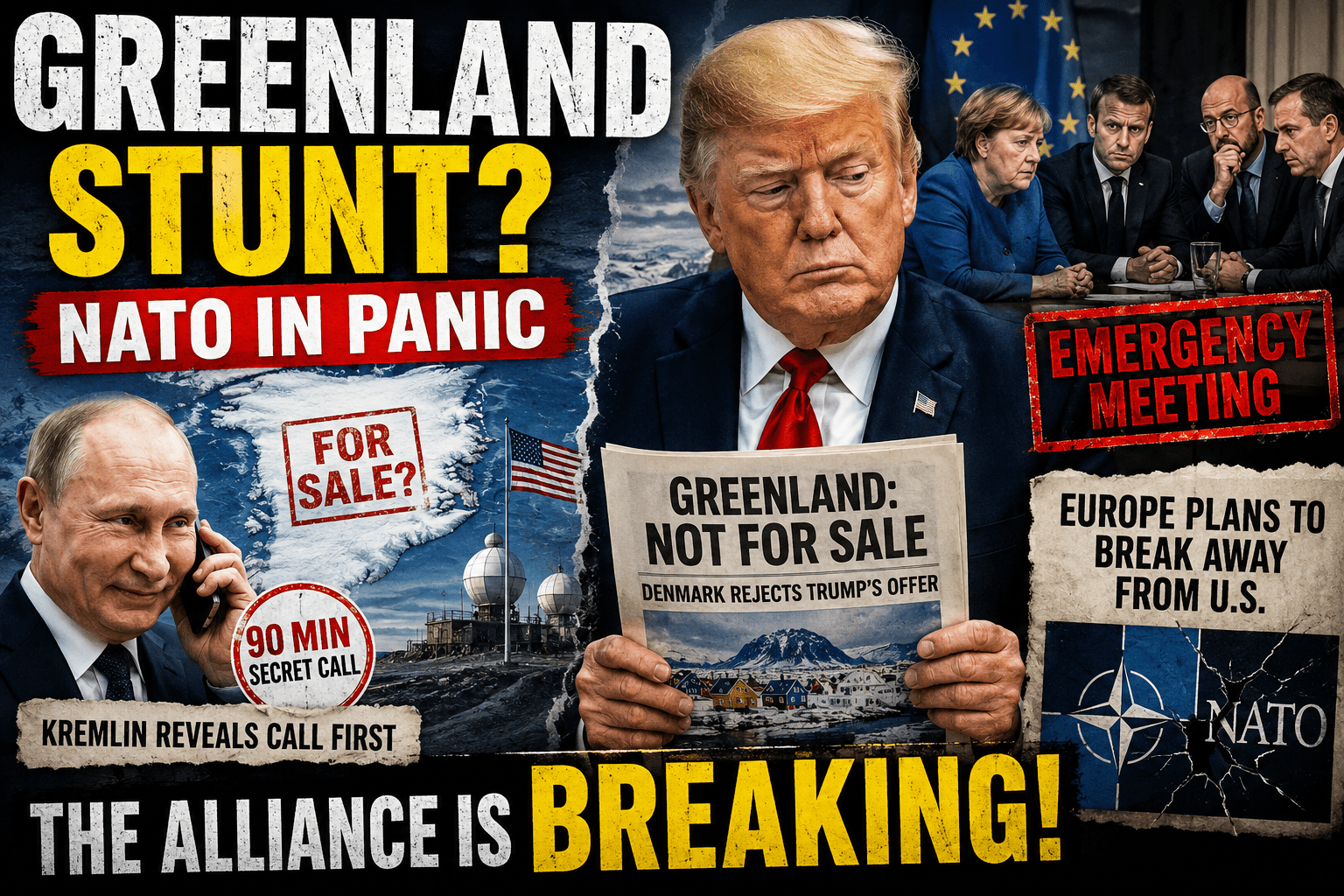
Right now, the headlines dominating your feeds sound like they were pulled straight from a late-night comedy sketch. We have the President of the United States inexplicably demanding to purchase Greenland—a sovereign territory of our ally, Denmark. We have clips circulating of foreign leaders openly laughing at us. We have bizarre press conferences that leave the entire diplomatic corps scratching their heads.
It is incredibly easy to look at this circus, roll your eyes, change the channel, and write it off as just another week of chaotic political theater.
But I need you to stay with me tonight, because we are going to look past the absurdity. We are going to connect the dots. When you strip away the noise, the reality of what is happening right now on the global stage is not a joke. It is a calculated, terrifying unraveling of the American-led global order. What we are witnessing is a deliberate wedge being driven straight through the heart of the NATO alliance, and our oldest, most trusted allies are officially hitting the panic button.
Let’s break down exactly what is happening behind closed doors, why the timing of this “Greenland stunt” is no accident, and what this actually means for the safety and economy of the everyday American.
The “Dead Cat” Strategy and the Arctic Reality
To understand the chaos, we first have to understand the tactic. In political strategy, there is a concept known as throwing a “dead cat” on the table. If you are losing an argument, or if there is a story you desperately want the public to ignore, you throw a dead cat on the table. Suddenly, nobody is talking about the original problem anymore; they are only talking about the dead cat.
The sudden, aggressive demand to buy Greenland is the ultimate dead cat.
On its face, it makes zero diplomatic or strategic sense. Yes, the Arctic is the geopolitical frontier of the 21st century. As the polar ice caps recede, new global shipping lanes are opening, and whoever controls those lanes controls the future of global trade. There are vast reserves of untapped rare earth minerals beneath that ice. But here is the critical fact that the administration is leaving out: The United States already has a strategic, militarized foothold in Greenland.
We operate Thule Air Base (now Pituffik Space Base) right there on the ice. We do not need to buy the landmass to secure our national security interests. We simply need to maintain a strong, cooperative, trusting relationship with the nation that actually owns it: our NATO ally, Denmark.
So, why would the administration aggressively demand to annex sovereign territory from a friendly democracy, knowing full well it would be rejected? Why manufacture a massive, unprovoked crisis that deeply insults our European partners?
Because blowing up the alliance is the point. And to understand who benefits from that, we have to look at the timeline.
The Undisclosed Call and the Kremlin’s Hand
If you want to know why American foreign policy suddenly swerved into oncoming traffic, look at what happened exactly before the President left for the NATO summit in Turkey.
Before the White House released a single statement, Russian state media—the Kremlin itself—announced to the world that the US President had engaged in a 90-minute, undisclosed phone call with Vladimir Putin.
Think about the gravity of that for a second. The American public and the American press had to find out from Moscow that our Commander-in-Chief was having a lengthy, secret conversation with a hostile foreign dictator just days before a summit designed to unify the West against that very dictator’s aggression.
The Kremlin’s Announcement
Pre-Summit
Russian state media reveals a 90-minute, undisclosed phone call between Putin and the US President. The White House is forced to admit it happened after the fact.
The Distraction Deployed
Summit Departure
The US suddenly revives the aggressive demand to annex Greenland, immediately injecting hostility and confusion into the NATO alliance.
Projecting Weakness
The NATO Summit
Instead of unifying the alliance, the US presence is marked by erratic behavior, alienating partners, and drawing mockery from other world leaders.
Europe Breaks Away
The Aftermath
European leaders hold a secret emergency session, concluding the US is a security risk and accelerating plans to decouple their militaries and tech sectors from America.
History has shown us a very clear, very disturbing pattern. Whenever these closed-door, undocumented conversations happen between this administration and the Kremlin, they are almost immediately followed by the United States introducing a bizarre, hostile talking point that directly harms our European partners.
This isn’t a random gaffe. This is a highly effective wedge issue. It dominates the news cycle, it creates infighting among democracies, and it fulfills Vladimir Putin’s number one geopolitical objective: destroying the NATO alliance from the inside out. Putin doesn’t have to fire a single shot to weaken the West; he just has to watch us tear ourselves apart.
The Secret Room in Brussels
If you want to grasp how much damage this has caused, you have to look at how Europe is reacting when the cameras are turned off. They are no longer treating this as a passing phase. They are no longer treating the United States as their protector. They are starting to treat us as an active security threat.
According to a stunning report from the Wall Street Journal, European leaders recently convened a marathon, emergency crisis meeting in Brussels. The protocols for this meeting were completely unprecedented for peacetime allies. Heads of state were ordered to arrive completely alone. No aides. No translators. No cell phones allowed in the room.
For decades, the strategy in capitals like Paris, London, and Berlin was to manage the United States. They would use flattery, offer minor trade concessions, and try to appeal to the President’s ego to keep the Transatlantic Alliance intact.
At that secret meeting in Brussels, French President Emmanuel Macron reportedly looked around the room and stated bluntly that the era of managing America was over. He declared that Europe’s reliance on the United States was now a fatal vulnerability. According to the reporting, Macron told his fellow leaders, “There is no going back.”
This is a seismic shift in world history. The people we stormed the beaches of Normandy with are looking at our government and deciding we can no longer be trusted.
Preparing for a “Hot War”
This breakdown of trust isn’t just diplomatic tough talk. It has escalated to a point that should send a chill down the spine of every American watching this.
According to the Journal report, France recently deployed soldiers to Greenland to participate in a joint Arctic operation with Denmark. The underlying, horrifying reality of that deployment was that those allied special forces were reportedly equipped and prepared for a “hot war”—a literal shooting war—with the United States military, should the administration attempt to aggressively force the Greenland issue.
Let that sink in.
For seventy-five years, American, French, and Danish troops have stood shoulder-to-shoulder against the Soviet Union, global terrorism, and instability. Today, the erratic, unpredictable nature of American leadership has driven our oldest friends to load their weapons and prepare to defend themselves against us. We have made our allies so paranoid, so uncertain of our intentions, that they view the American military as a potential hostile occupying force.
The Economic Divorce: Ripping Out American Tech
While the prospect of a military standoff is terrifying, the quiet, structural divorce happening right now will have an immediate, devastating impact on the American economy.
Europe has realized that if they cannot trust the American commander-in-chief, they cannot trust American infrastructure. A massive campaign of “de-Americanization” is currently sweeping across the continent.
Governments from France to the Netherlands are quietly but rapidly ripping American technology out of their systems. They are actively instructing civil servants to stop using Microsoft Teams, Office, and American cloud servers. They are migrating to European-built, open-source software. They are pouring hundreds of billions of dollars into their own private space firms, their own artificial intelligence startups, and their own data centers.
They are doing this for one specific reason: to avoid leaning on American tech juggernauts.
For the average American, this might sound like a distant corporate problem, but it is a direct hit to your wallet and our economy. The European Union is one of our most vital markets. When Europe bans American software and shifts its defense and tech spending inward, it translates to billions of dollars in lost revenue for US companies. It means fewer jobs for American engineers, developers, and manufacturers. It means American startups will find the doors to the European market slammed completely shut.
We are voluntarily surrendering our dominance in the global tech and defense sectors because our political leadership has made the United States too volatile to do business with.
The Intelligence Blackout
This breakdown extends deep into the shadows of global intelligence. The “Five Eyes” intelligence-sharing network—comprising the US, UK, Canada, Australia, and New Zealand—is the most powerful and effective espionage apparatus in human history. It relies entirely on absolute, unquestioned trust. If British spies uncover a terrorist plot against New York, they hand that intelligence to the CIA immediately, knowing it will be handled safely.
That trust is currently evaporating.
We are seeing reports of chilling warnings from Britain’s MI6 to their own Prime Minister. MI6 assessed the current environment in Washington not as a functioning, rational government, but by comparing it to the paranoid, blood-soaked court of King Henry VIII. They are telling their leadership that Washington is consumed by internal chaos, paranoia, and erratic behavior.
More dangerously, British spy agencies have reportedly instructed their staff not to discuss the American President with their CIA counterparts. When allied spy agencies are afraid to speak openly with American intelligence because they fear the information will be mishandled, weaponized for domestic politics, or simply handed over to adversaries like Russia, the American homeland becomes significantly less safe. We are intentionally blinding our own radar.
The Ultimate Trap: Testing Article 5
All of this chaos, this division, and this economic divestment leads us to one ultimate, terrifying vulnerability: the death of NATO and the end of the post-World War II peace.
The North Atlantic Treaty Organization is built on a single, non-negotiable premise known as Article 5. It simply states that an armed attack against one member is considered an attack against all members. It is the reason Soviet tanks never rolled into Paris or London during the Cold War. The absolute certainty that the United States would rain hellfire on anyone who touched a NATO ally has been the bedrock of global stability for generations.
But what happens when that certainty is gone?
European intelligence agencies are living in a state of near-panic right now because they believe Vladimir Putin is preparing to test this exact vulnerability. The fear is not necessarily a massive, full-scale invasion of a major power like Germany. The fear is a targeted, limited military incursion into a smaller NATO country—perhaps in the Baltics—designed purely as a stress test.
Putin wants to prove to the world what he already suspects: that if he attacks a NATO ally, the current American leadership will not respond. If the US President hesitates, if he makes excuses, or if he claims that defending a small European nation simply isn’t worth American money, NATO dies on the spot.
The moment the United States fails to honor Article 5, the treaty becomes a worthless piece of paper. The alliance completely collapses. The global map will instantly revert to the law of the jungle, where strong nations consume weak ones without fear of American intervention. China will look at Taiwan with new eyes. Authoritarians everywhere will realize that the world’s policeman has permanently walked off the job.
The Bottom Line
When foreign leaders look at the United States right now, they do not just see a volatile individual in the Oval Office; they see a fundamentally broken system.
They see a country so deeply polarized, so exhausted by culture wars, and so entirely consumed by reality-television politics that it is allowing its foreign policy to be manipulated by foreign dictators. They are assessing us not just on the actions of one administration, but on the cultural rot that allowed this situation to occur in the first place.
If we want to understand why our closest friends are walking away, we have to look in the mirror. You cannot project strength abroad when your institutions are decaying at home.
The situation we are watching unfold right now—from the laugh tracks at international summits to the movement of troops in the freezing Arctic—is the sound of the American century ending. Reversing this will require more than just changing the channel on the news, and it requires more than just waiting for the next election cycle.
It requires the American public to wake up, to recognize the catastrophic danger of treating global diplomacy like a game show, and to demand a return to serious, stable, and reliable governance. Because if we don’t, the isolation we are building for ourselves will become permanent, and the world we leave behind will be vastly darker, and infinitely more dangerous.
Thank you for your time tonight. Stay informed, stay vigilant.
As a common citizen, I believe the world needs peace and cooperation right now, not new conflicts. Leaders should focus on global stability rather than power struggles
right