Welcome back. If you’ve been scrolling through social media, reading the news, or just talking to your neighbors lately, you might feel like you’ve stumbled into a political thriller, or maybe a really dark episode of Veep. Right now, one of the most powerful men in Washington—a man who has shaped the American judiciary and the legislative landscape for decades—has practically vanished.
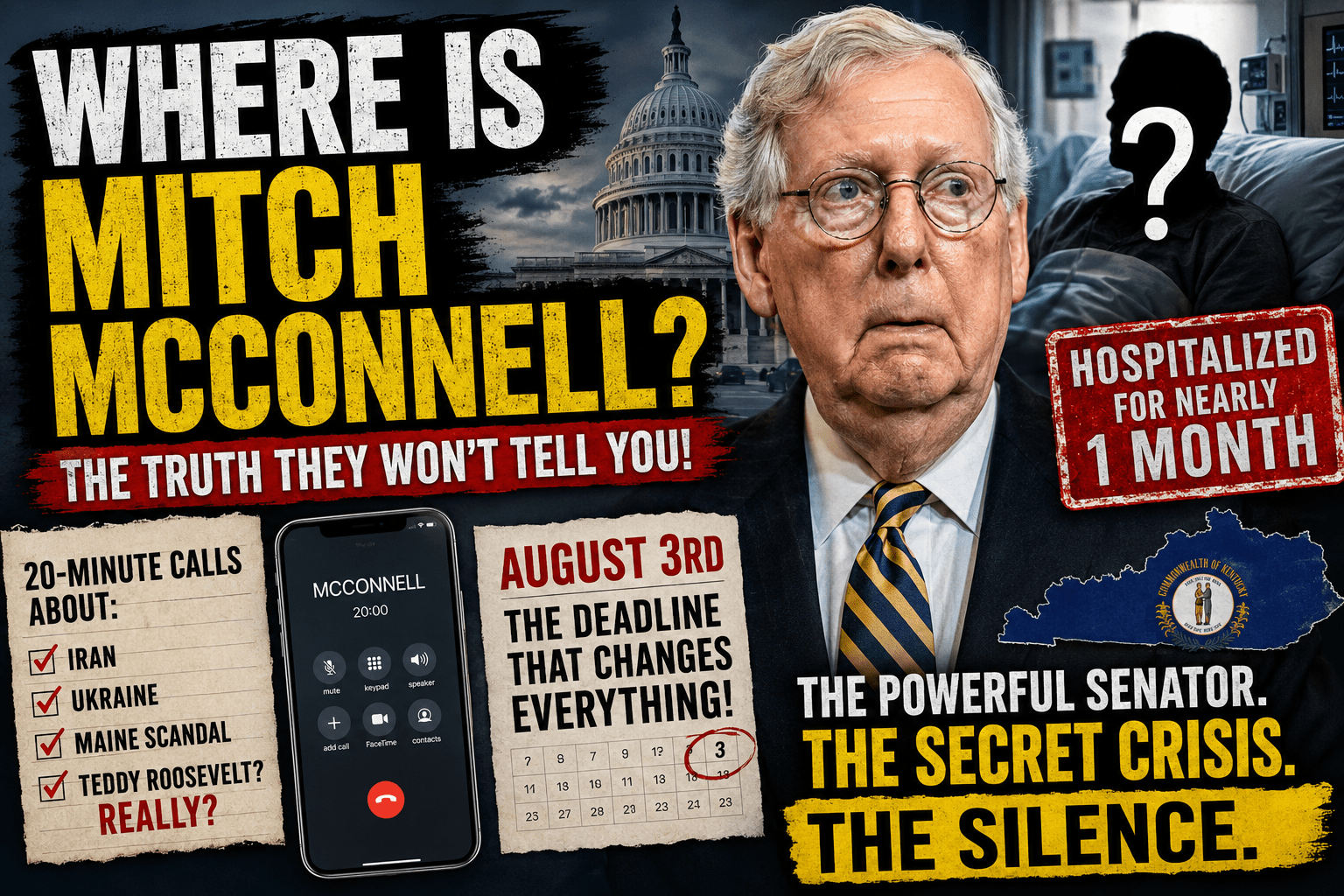
Senator Mitch McConnell has been in a hospital for nearly a month. No photos. No videos. No detailed medical briefings. Just a deafening silence from his office, punctuated by a handful of allies insisting that he is perfectly fine, just making 20-minute phone calls about global geopolitics from his hospital bed.
It is a story that sounds absurd, but it touches on a deeply serious, systemic crisis in American politics: our leaders are aging, they are facing severe health crises, and the political machinery built around them is continually choosing secrecy over the public’s right to know.
Let’s pull back the curtain on the Mitch McConnell mystery, the ticking clock in Kentucky, and why the bipartisan habit of hiding health issues is destroying what little trust remains in our government.
The Timeline of the Disappearance
To understand why the internet is currently exploding with “proof of life” demands, we have to look at the timeline.
On the morning of June 14th, Senator McConnell was rushed to the hospital. His office put out a brief, incredibly vague statement saying he was admitted and receiving “excellent care.” That was essentially it.
But behind the scenes, the reality seemed much more dire. Emergency dispatch audio obtained by journalists painted a terrifying picture. Paramedics were called to McConnell’s address for an “unconscious” person. Minutes later, a medic radioed that CPR was in progress, and the emergency was classified as a cardiac arrest.
Now, we know McConnell is 84 years old. He is a polio survivor who has had a well-documented history of severe falls, concussions, and terrifying moments where he froze completely in front of live television cameras. If an 84-year-old man suffers a cardiac event requiring CPR, that is a massive medical trauma. Recovery is brutal, long, and sometimes impossible to fully achieve.
Yet, his office has acted as if he simply caught a mild summer cold. They have offered virtually no updates, only claiming he is “improving” and “working closely with staff.”
And then, the narrative got weird.
The 20-Minute Phone Calls
Nature abhors a vacuum, and politics abhors it even more. Because McConnell’s office refused to release a simple 60-second video showing the Senator in a chair waving to the camera, the MAGA wing of the Republican party—a faction that has constantly clashed with McConnell—stepped into the void.
Conservative commentators like Laura Loomer started posting that high-level sources told them McConnell was “officially brain dead” and would never return. Conspiracy theories ran wild. Was he in a coma? Was his staff pulling a Weekend at Bernie’s to maintain their own power?
In a desperate attempt to put out the fire, the Republican establishment deployed its messengers. Suddenly, we heard from GOP Whip John Barrasso, Senate Majority Leader John Thune, and conservative political commentator Scott Jennings. They all claimed to have just gotten off the phone with Mitch McConnell. And not just brief check-ins—they claimed they had 17 to 20-minute, highly substantive conversations.
Jennings said they talked about Iran, the war in Ukraine, an unfolding political scandal in Maine, and the history of the Teddy Roosevelt presidency.
Let’s apply some common sense here. If you have been in a hospital bed for three weeks after a highly suspected cardiac arrest, are you really burning the phone lines debating the finer points of the Theodore Roosevelt administration? Maybe. But to the American public, it sounds incredibly manufactured. It sounds like a coordinated talking point.
If McConnell is strong enough to have a 20-minute strategic debate about the Supreme Court with John Barrasso, he is strong enough to hold up a smartphone and record a 15-second video telling the people of Kentucky that he is okay. The fact that his team refuses to do that suggests that the reality of his physical condition simply does not match the talking points being distributed to the press.
The Ticking Clock: The August 3rd Deadline
Why hide the truth? In politics, the answer usually comes down to two things: power and self-preservation.
If McConnell were to resign right now, or if it were confirmed that he is fully incapacitated, it would trigger a massive political earthquake. The Senate map is razor-thin, and the Republican majority cannot afford extended absences. But there is also a very specific calendar date driving the paranoia right now: August 3rd.
Under Kentucky law, there are strict deadlines for when a special election can be held to replace a vacant Senate seat. If McConnell’s seat becomes vacant before August 3rd, it completely alters the political timeline. His staff, his political allies, and the institutional Republican party know that a sudden, chaotic special election in Kentucky could be a nightmare.
Furthermore, you have to look at the human element. The staff surrounding a powerful Senator like McConnell rely on him for their livelihoods, their influence, and their status in Washington. If he resigns, they lose their jobs. If he stays in office—even if he is incapacitated in a hospital bed—the machinery keeps running. The staff keeps drafting statements. The lobbyists keep calling. The power remains intact.
But this is not a uniquely Republican problem. This is a Washington problem.
A Bipartisan Epidemic of Secrecy
When we look at the McConnell situation, we have to recognize that this is part of a deeply disturbing trend of politicians and high-level officials vanishing without telling the public.
Let’s roll back the tape.
Just a couple of years ago, Defense Secretary Lloyd Austin—the man responsible for the United States Armed Forces, the man who sits in the chain of command for our nuclear arsenal—went entirely AWOL. He was hospitalized for days, undergoing surgery and spending time in the intensive care unit, and he didn’t tell anyone. He didn’t tell the press. He didn’t tell Congress. He didn’t even tell the President of the United States.
When he was finally caught, the excuse was that he was a “private guy.” Austin later had to sit in front of Congress and admit he was wrong, stating that when you take a job at that level, you forfeit a certain amount of your medical privacy. The American people have a right to know if the person commanding their military is awake, alert, and capable.
But Congress clearly didn’t learn the lesson, because the legislative branch is full of similar ghosts.
Take Representative Tom Kean Jr., who disappeared from Washington for months. No votes. No public appearances. No explanation to his constituents. When he finally returned, he cited severe depression. We must have boundless empathy for anyone suffering from mental health crises—the stigma is real, and the battle is grueling. But empathy does not negate duty. If an average American stops showing up to their job for three months without telling their boss, they are fired. A member of Congress is a federal employee. The taxpayers are their boss. You cannot simply ghost the American people while holding a voting seat in the United States government.
Or consider Representative Kay Granger. She was quietly moved into an assisted living facility for dementia care in 2024, and the political establishment barely blinked.
And of course, we have spent years debating the cognitive and physical health of President Joe Biden, with the White House fiercely shielding him from unscripted moments, leading to massive public anxiety about whether the people elected to run the country are actually the ones running it.
The Danger of the Vacuum
Why is this culture of silence so incredibly dangerous?
First, it breeds absolute, toxic distrust. We are living in an era where faith in American institutions is at rock bottom. When the government refuses to be honest about something as basic as the physical location and health of a Senator, why should the public believe them about the economy, about foreign wars, or about the safety of their communities?
When leaders create an information vacuum, conspiracy theorists will gladly fill it. The refusal of McConnell’s team to be transparent didn’t protect his dignity; it actually subjected him to cruel internet rumors. It allowed political opportunists to declare him “brain dead.” Secrecy doesn’t protect politicians anymore; it just feeds the outrage machine.
Second, it deprives the voters of their fundamental democratic rights. When you vote for a Senator, you are hiring them to do a job. You are hiring them to read legislation, debate policy, and cast votes that will affect your taxes, your healthcare, and your children’s future.
If that person is on a ventilator, or severely cognitively impaired, or recovering from a massive cardiac arrest, they cannot do the job. And if they cannot do the job, the voters have a right to know so they can replace them. Kentucky Governor Andy Beshear recently sent a formal letter to McConnell’s office begging for a transparent update, noting that allowing media speculation to run wild is unfair to Kentuckians. He is absolutely right. The people of Kentucky currently have only one functioning Senator in a chamber where every single vote counts.
The Hubris of Washington
So why do they do it? Why do politicians cling to the office until the bitter end, hiding their frailties behind press secretaries and locked hospital doors?
It comes down to hubris.
When you have been in Washington for thirty, forty, or fifty years, your entire identity becomes fused with your office. You are no longer just Mitch McConnell from Louisville; you are The Leader. You are the architect of the Senate. To admit physical infirmity is to admit mortality. It is an incredibly difficult psychological hurdle for powerful men and women to accept that the world will keep spinning without them.
Furthermore, there is a generational disconnect. Many of these octogenarian leaders grew up in an era where the press happily covered up the ailments of politicians. The media hid FDR’s wheelchair. They hid JFK’s crippling back pain and Addison’s disease. Older politicians still operate under the illusion that they are entitled to that kind of gentleman’s agreement with the press.
But it is 2026. Everyone has a smartphone. Emergency dispatch audio leaks. Flight trackers show when a politician’s spouse flies back from China. The era of the grand political cover-up is over. The only thing secrecy accomplishes today is making the politician look deceitful and weak.
Where We Go From Here
The situation with Mitch McConnell is a tragic, messy chapter for a man who, love him or hate him, is one of the most effective legislative tacticians in American history. But this is a terrible way to manage an exit.
We need a fundamental shift in how Washington handles the health of its leaders. We cannot rely on the honor system anymore, because the honor system is broken. Congress must pass internal rules mandating medical transparency. If a member of the House or Senate is hospitalized and unable to perform their duties for an extended period, an independent, bipartisan medical assessment should be released to the public.
If you want the privilege of holding the highest offices in the land, you have to accept the burden of public scrutiny. You do not get to wield the power of the federal government in secret.
The American people aren’t stupid. They know when they are being managed, and they know when they are being lied to. It is time for the political class to stop hiding in hospital rooms and start treating the public with the respect they deserve. If a leader is too sick to stand before a camera and speak to the people who hired them, they are too sick to hold the office. It really is that simple.