WASHINGTON — In the history of Washington power struggles, few scenes quite match the sheer political drama that unfolded on a military tarmac this past Friday.
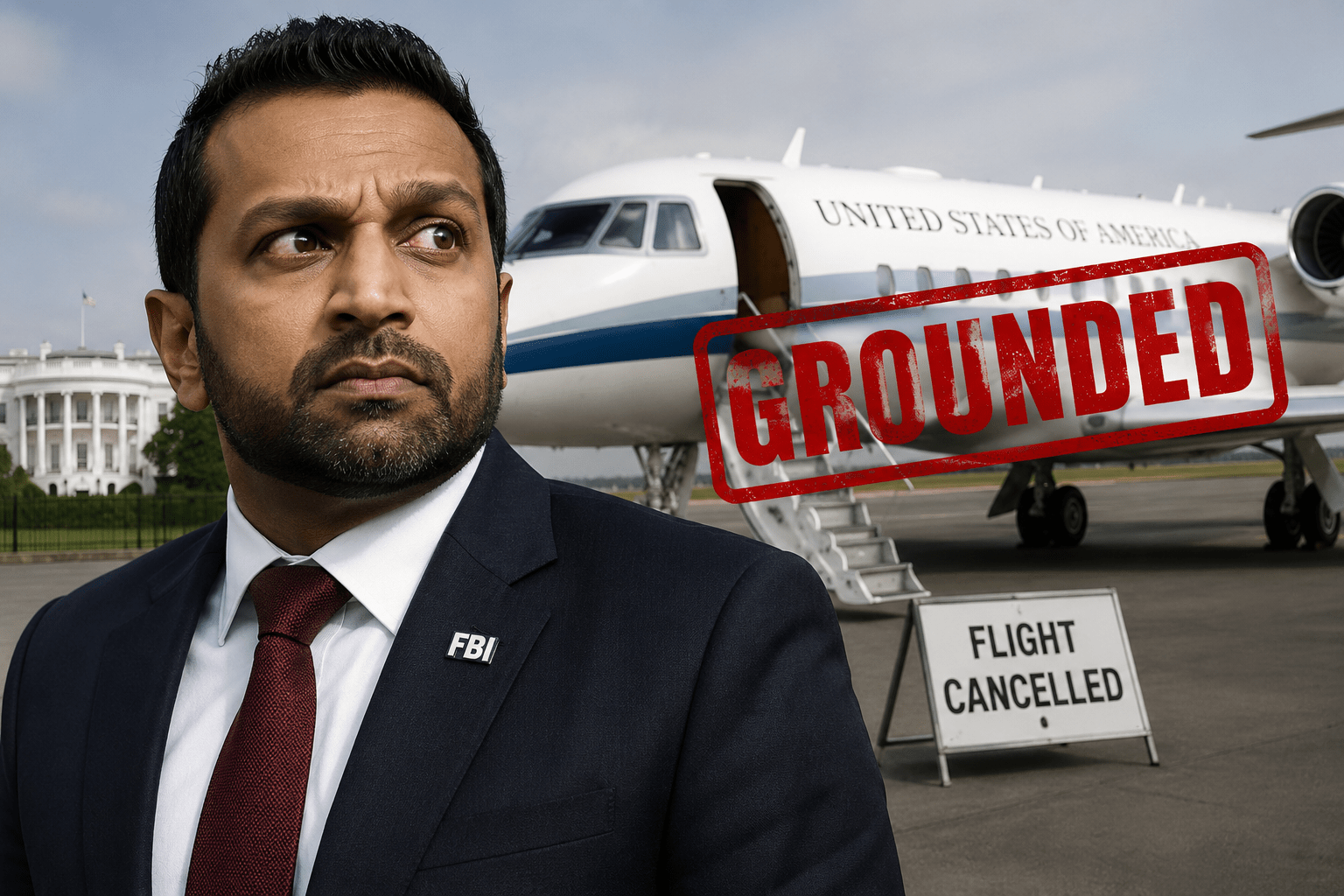
An internal administration crisis reached its breaking point when FBI Director Kash Patel found his official government-funded jet effectively commandeered before takeoff. According to senior administration sources, Patel was preparing to fly to Chicago when a direct order from the West Wing abruptly grounded the aircraft.
Instead of flying out to America’s third-largest city, the nation’s top law enforcement official was summoned directly to the White House. There, he faced a barrage of furious rebukes from senior administration officials. The dramatic intervention underscores a rapidly escalating war over optics, taxpayer-funded luxury, and institutional accountability that now threatens Patel’s tenure at the head of the bureau.
The Chicago Connection and the “Cover” Story
At the heart of the immediate tarmac showdown was a planned weekend trip to Illinois. Ostensibly, Director Patel had scheduled a formal visit to the FBI’s Chicago field office—a routine task for any director looking to maintain ties with regional offices.
However, sources within the bureau indicate that rank-and-file field agents reacted to the scheduled visit with deep resentment. Among the rank-and-file, the trip was widely viewed as a thin cover. The true objective? Arranging a taxpayer-funded excursion to allow Patel to attend a major country music street festival, where his girlfriend was scheduled to perform.
For an agency built on a culture of rigid professionalism, the optics of using a multi-million dollar government aircraft for personal leisure—disguised as official business—proved highly toxic.
A Pattern of High-Flying Excess
The aborted Chicago flight is not an isolated incident. Rather, it represents the tipping point of a mounting dossier of alleged ethical lapses surrounding Patel’s travel habits and lifestyle enhancements.
Reports have steadily emerged painting a picture of an executive office treating federal resources as a personal concierge service. Among the most damaging allegations:
- The Nashville Outing: Law enforcement sources allege that during an earlier trip to Nashville, Tennessee, the Director’s federally funded security detail was effectively utilized as a private transport service for Patel’s girlfriend and her companions following a night out.
- The Luxury Armored Fleet: Concerns have been raised regarding Patel’s demands for customized, high-end armored vehicles. Specifically, the procurement of luxury armored BMWs for his travel within the Washington, D.C. metropolitan area has raised eyebrows, with critics noting such vehicles are far less discreet than standard government-issued suvs.
- Specialized Excursions: Congressional investigators are reviewing internal communications alleging that Patel frequently pressured FBI staff to coordinate recreational perks during official travel, including helicopter tours and jet ski excursions.
While the FBI’s public information office has consistently maintained that Patel’s travel complies with federal guidelines, the sheer volume of high-flying complaints has systematically eroded his political capital within the capital.
The Social Media Misstep: “Gold-Plated Jet Skis”
Compounding the administration’s frustration is Patel’s highly combative public relations strategy. As investigative reports regarding his lifestyle grew louder, Patel chose to bypass standard institutional channels, taking to social media to confront his critics directly.
Responding to a critical article detailing his travel expenses, Patel posted a blunt rebuttal on X (formerly Twitter):
“Nah my jet ski is goldplated dumbass your job is to lie mine is to protect the American people and business is good.”
Within the West Wing, the response was swift and intensely negative. For an administration highly attuned to working-class optics, the image of an FBI director bragging about a “gold-plated jet ski” while trading petty insults online was viewed as an unforced error. Instead of projecting strength, the post was interpreted by top White House advisers as defensive, immature, and out of touch with everyday Americans.
Bipartisan Backlash on Capitol Hill
Perhaps the most dangerous development for Patel is that the frustration has spread beyond the media and deep into the halls of Congress. Significantly, the scrutiny is no longer coming exclusively from political opponents.
On Thursday, it was revealed that Senate Judiciary Chairman Chuck Grassley—a powerful Republican, a staunch ally of the President, and a legendary watchdog against government waste—had sent a formal letter to the FBI demanding an immediate accounting of Patel’s expenses. Grassley’s inquiry specifically targets the acquisition of the armored luxury BMWs and the exact justification for numerous high-cost flights.
When a figure as influential as Grassley demands receipts, the political calculation changes instantly. The White House recognizes that defending a controversial official against opposition attacks is standard politics; defending an official against their own party’s most respected oversight hawk is a losing battle.
A Dangerous Vacuum in National Security
What makes the timing of Patel’s aborted weekend travel particularly egregious to national security officials is the current global landscape. The United States is presently navigating a period of heightened geopolitical friction, marked by active threat streams originating from Iran and renewed concerns regarding domestic political violence.
For the director of the primary domestic intelligence and security agency to be focused on coordinating festival attendance in the middle of an international security crunch is being characterized by critics as a severe dereliction of duty.
Furthermore, the friction within the FBI coincides with separate logistical embarrassments plaguing the executive branch. Recent reports indicating that a refurbished $400 million aircraft—originally provided via diplomatic arrangements with Qatar—was deemed insufficiently secure to transport the President directly from the NATO summit to the United Kingdom have already left the administration highly sensitive to security-related optics.
Against this backdrop of systemic vulnerabilities, the top cop’s focus on a personal itinerary created an unsustainable distraction.
The Structural Fallout
The current crisis highlights a structural vulnerability of Patel’s own making. Upon taking control of the bureau, Patel initiated an aggressive internal restructuring, systematically removing career leadership figures who raised questions regarding compliance and replacing them with highly loyal political appointees.
While this strategy successfully insulated Patel from internal whistleblowers during his first months in office, it ultimately backfires in a crisis. By surrounding himself exclusively with enablers, Patel severed the internal feedback loops that traditionally protect a high-ranking official from their own worst impulses. Without a seasoned chief of staff or career deputy willing to say “no” to a questionable travel request, the Director walked directly into a political ambush on the tarmac.
A Director on Borrowed Time
Washington is a city that forgives many things, but it rarely forgives a combination of high visibility, high expense, and low institutional utility. As the investigations by the Senate Judiciary Committee intensify and the internal resentment within the FBI field offices boils over, the question is no longer whether Kash Patel has damaged his standing, but whether he can survive it.
For the American public, the episode serves as a stark reminder of the fragile balance between public service and personal privilege. At a time when the nation requires absolute focus from its intelligence apparatus, the top law enforcement agency in the world finds its leadership grounded by a self-inflicted storm of bad choices, bad tweets, and gold-plated distractions.