WASHINGTON — There is an unwritten, yet foundational understanding in American governance that the doorstep of a journalist is a line federal law enforcement does not cross merely for the crime of reporting uncomfortable facts. On Friday evening, that line was systematically erased.
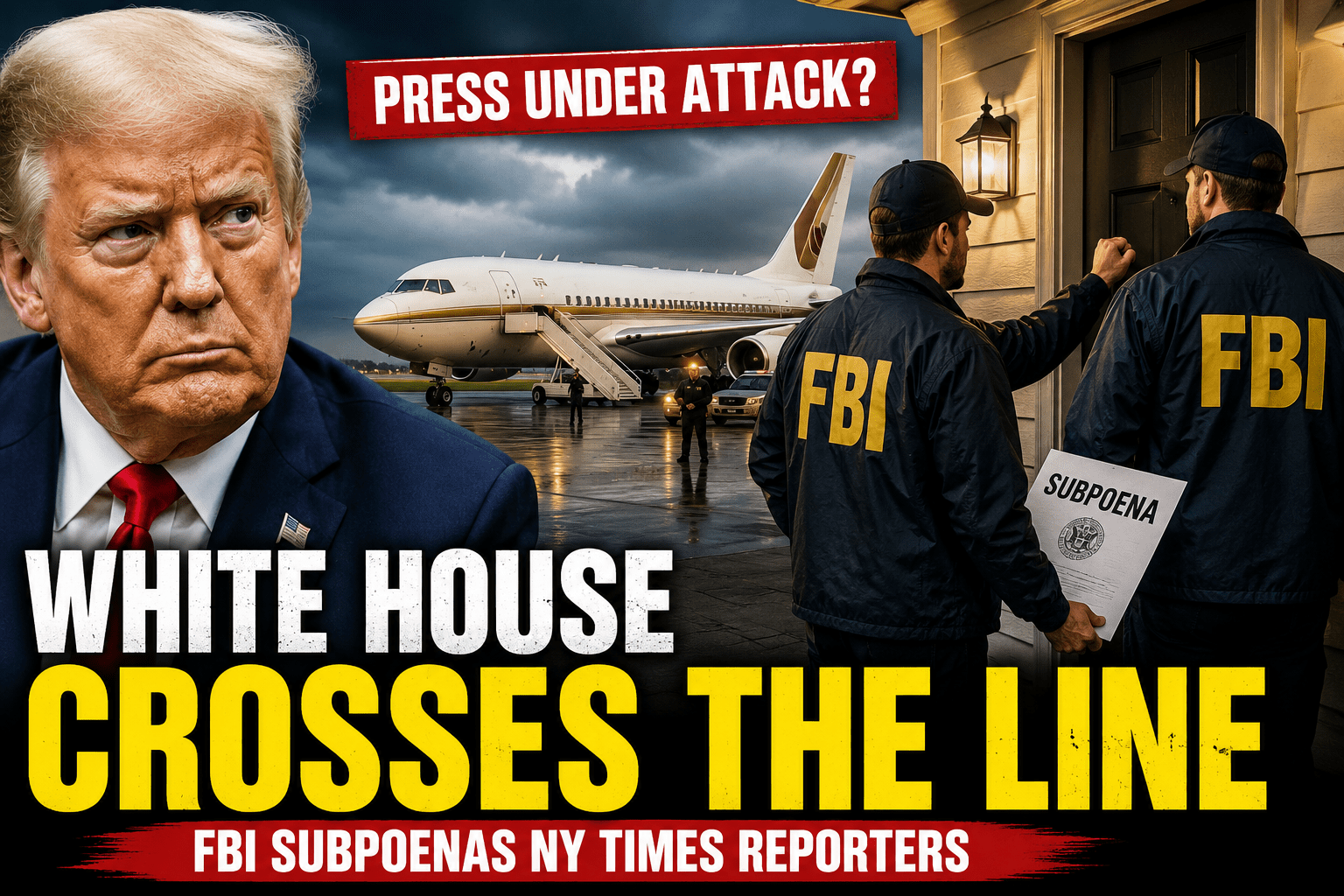
In a dramatic escalation that has sent shockwaves through the American press corps and drawn rare, sharp condemnation from across the ideological spectrum, the Department of Justice issued federal subpoenas to four prominent national security reporters for The New York Times. The orders, demanding their appearance before a Manhattan grand jury this Wednesday, were not delivered via standard legal counsel. Instead, they were hand-served by federal law enforcement agents appearing directly at the journalists’ private residences.
The target of the administration’s fury? A series of deeply sourced, embarrassing investigative reports revealing severe, unmitigated security flaws within Donald Trump’s newly acquired, Qatari-donated alternative to Air Force One—vulnerabilities so acute they recently forced the President to abruptly switch aircraft on a tarmac during the NATO summit in Turkey.
The aggressive legal maneuver marks a historic escalation in the executive branch’s campaign against independent journalism, drawing a stark warning even from within conservative media spaces. “This action by the U.S. government to subpoena reporters for reporting legitimate news on security concerns about Air Force One should alarm every American,” warned Jennifer Griffin, Chief National Security Correspondent for Fox News. When Fox News and The New York Times find themselves standing shoulder-to-shoulder in defense of press freedoms, Washington has entered entirely uncharted, and deeply perilous, constitutional territory.
The Tarmac Inversion: How a $400 Million Gift Became a National Security Failure
The flashpoint for this constitutional crisis sits on a secure military runway. On Thursday, The New York Times published a detailed expose authored by the subpoenaed quartet: Julian E. Barnes, Eric Lipton, Tyler Pager, and Eric Schmitt. The reporters revealed that the President’s preferred new aircraft—a luxury Boeing 747-8 originally gifted to Trump by the government of Qatar—is fundamentally unequipped to handle the rigorous defensive demands of the modern presidency.
According to the reporting, which relied on senior intelligence and defense sources speaking on the condition of anonymity, the Qatari jet lacks critical, high-grade military countermeasures, including advanced anti-missile defense systems and electromagnetic pulse (EMP) shielding standard on the decades-old VC-25A aircraft traditionally used as Air Force One. The missing infrastructure turns the flying executive office into a massive, vulnerable target during international transits.
The reality of these deficiencies collided with geopolitics at the recent NATO summit in Turkey. Confronted with heightened threat streams and an escalating, multi-front stand-off with Iran, military commanders deemed the luxury Qatari jet too dangerous to navigate international airspace. In a highly disruptive, embarrassing logistical pivot, the President was forced to abandon his preferred aircraft on the tarmac and board a heavily armored, traditional military jet to ensure a safe transit to the United Kingdom.
The administrative reaction to the disclosure was swift and defensive. The American public now faces a troubling mathematical reality: taxpayers have already spent an estimated $400 million—and potentially upwards of $1 billion in redirected defense funds—to retrofit this “gifted” luxury commercial airliner. Yet, despite the staggering expense, the aircraft remains vastly inferior in security capabilities to the older planes it was meant to replace. Rather than addressing the procurement failure, the administration chose to shoot the messengers.
The Knock at the Door: The Friday Night Subpoenas
The execution of the subpoenas on Friday evening signaled a deliberate departure from established Department of Justice protocols regarding media organizations. Traditionally, under long-standing guidelines designed to protect the First Amendment, the government exhausts all alternative investigative avenues and engages in extensive negotiations with newsroom leadership before taking the extraordinary step of forcing a journalist to testify.
The administration discarded that playbook. Federal agents arrived unannounced at the private homes of the four reporters, handing over legal commands containing minimal legal text. The documents noted only that the journalists were being summoned to testify “in regard to an alleged violation of federal criminal law.”
The institutional backlash from The New York Times was immediate and unsparing. David McCraw, the publication’s top newsroom lawyer, issued a fiery rebuke:
“The appearance of federal law enforcement agents on the doorstep of news reporters should shock the conscience of any American who believes in the Constitution and the press freedom it protects. Our journalists report the facts to advance the American public’s right to know how their government is operating and how their taxpayer dollars are being used. This brazen act should be seen as nothing more than an attempt to prevent the public from knowing what’s happening in their country by intimidating journalists from doing their jobs.”
The Department of Justice, via spokeswoman Emily Covington, attempted to frame the escalation as a standard, albeit rigid, leak investigation. “Reporters are not the targets; those leaking classified information are,” Covington asserted in a Saturday statement. “We value and appreciate the important role that the press plays in this country, but the DOJ also plays an important role to make sure that the people entrusted with our nation’s secrets do what they’re supposed to do with that information. We recognize there may always be a natural tension there, but we are not going to ignore the law.”
The Kash Patel Factor: A Desperate Bureau on the Defensive
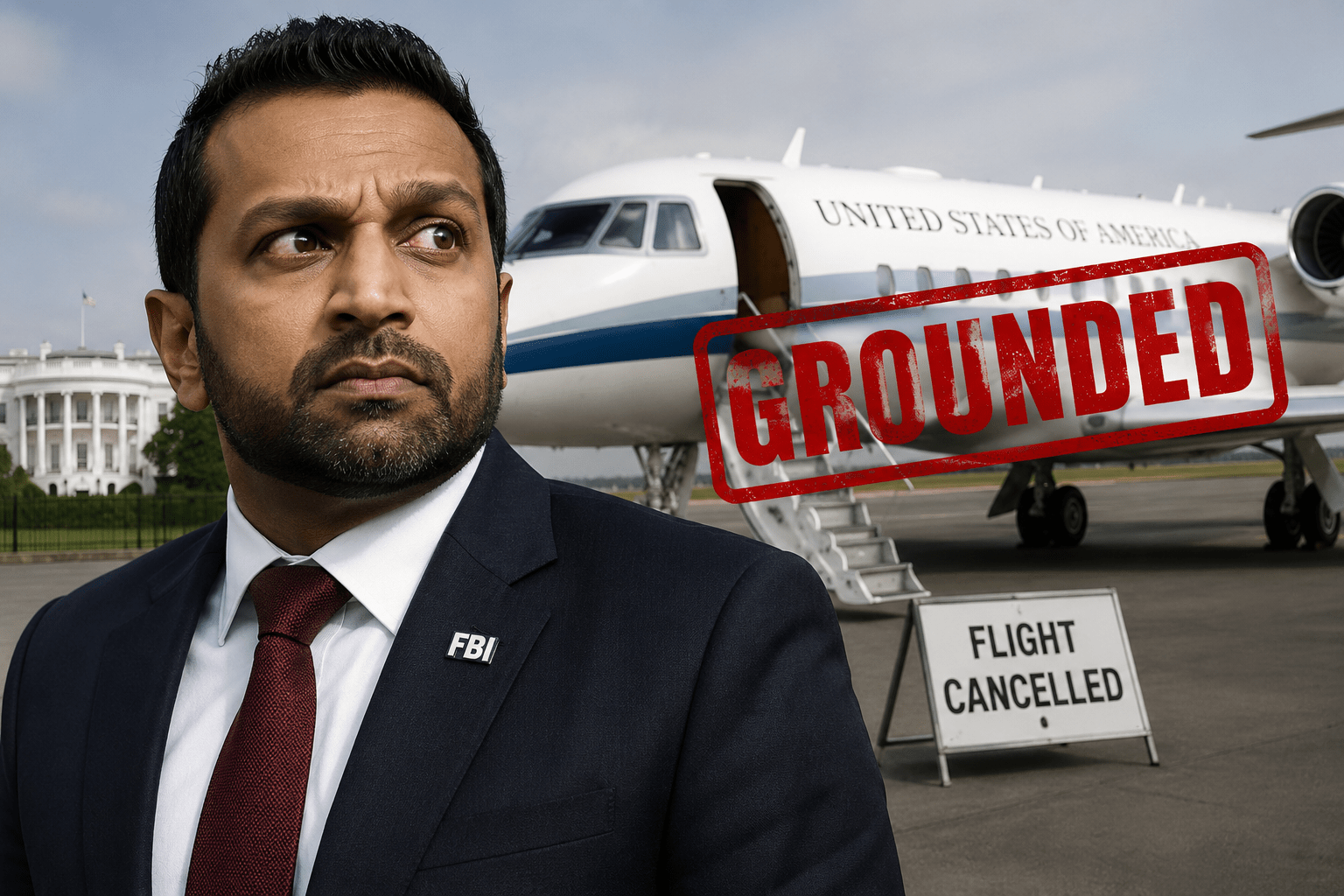
The aggressive push to weaponize the DOJ against the press cannot be separated from the intense institutional chaos plaguing the Federal Bureau of Investigation. On Friday afternoon, hours before the subpoenas were served, FBI Director Kash Patel was spotted by CNN journalists leaving the White House campus following an intense, unannounced meeting with senior executive advisers.
Sources close to the administration indicate that Patel has been under intense fire from West Wing political bosses over separate, rampant allegations of personal misconduct, including the systemic misuse of government-funded aircraft for personal leisure, unforced public relations blunders involving social media broadsides, and a complete breakdown of trust with powerful congressional allies like Senate Judiciary Chairman Chuck Grassley.
THE FRIDAY CONFRONTATION TIME-LINE
===========================================================
[12:00 PM] — Internal FBI panic over mounting procurement scandals.
[02:30 PM] — FBI Director Kash Patel arrives at White House for crisis meetings.
[05:00 PM] — DOJ finalizes emergency grand jury subpoenas for NYT journalists.
[06:44 PM] — Patel spotted by CNN departing the West Wing campus.
[08:15 PM] — Federal agents arrive at journalists' homes to serve subpoenas.
===========================================================
ANALYSIS: The rapid pivot to targeting journalists is widely interpreted
as an institutional effort to shift focus away from leadership failures.
The sudden, unprecedented crackdown on The New York Times is viewed by veteran Washington analysts as a desperate defensive play by Patel. Faced with a potential termination, the FBI Director appears to be utilizing the immense surveillance and legal apparatus of the state to launch a high-visibility leak hunt, attempting to rebuild his standing with the President by aggressively punishing the sources who exposed the Air Force One security failures.
Prior to the publication of the article, a senior FBI official reportedly contacted the Times editorial board, demanding they spike the story entirely under the umbrella of “national security,” while simultaneously demanding the newspaper turn over its confidential sources. The Times flatly refused.
A Broad Campaign of Executive Intimidation
First Amendment advocacy groups warn that the targeting of the Times is the culmination of a broader, systemic campaign to dismantle independent media oversight during the administration’s second term. Independent watchdogs, including the non-partisan libertarian group FIRE (Foundation for Individual Rights and Expression), have sounded an unprecedented alarm, characterizing the executive branch’s recent actions as “sensorious on a scale unprecedented in scope, scale, and severity.”
The numbers and actions back up that bracing assessment. The administration has repeatedly tested institutional boundaries over the past several months:
- The Intercepted Hardware: In January, FBI agents took the extraordinary step of executing a physical search warrant on the home of Washington Post reporter Anna Nathanson. Agents seized laptops, personal smartphones, and digital smartwatches, disrupting months of reporting on the administration’s efforts to dismantle the federal civil service.
- The Retracted Subpoenas: Earlier this year, the DOJ issued similar grand jury subpoenas to journalists at The Wall Street Journal and The Washington Post, only withdrawing the commands after both publications mounted massive, expensive, and legally complex counter-offensives in sealed federal filings.
- The Regulatory Retaliation: Following critical coverage of the executive branch’s defense policies, the Equal Employment Opportunity Commission (EEOC) launched a sudden employment discrimination lawsuit against The New York Times. The media company filed a formal counterclaim on Friday, explicitly designating the federal lawsuit as a illegal act of state retaliation designed to chill their First Amendment rights.
The Broader Cost: Financial and Institutional Malfeasance
Beyond the profound constitutional concerns, the Air Force One scandal exposes a staggering level of fiscal and logistical incompetence. During his first term, Trump negotiated a highly publicized multi-billion dollar contract with Boeing to manufacture two brand-new, state-of-the-art replacements for the aging Air Force One fleet. Those custom aircraft are still undergoing production and testing, an intricate process that naturally takes years to complete.
Rather than utilizing the perfectly secure, existing presidential fleet for the remaining two years of development, the President insisted on bypassing standard military procurement to introduce the Qatari commercial jet into active service. The decision effectively forced the American taxpayer to foot a massive, nearly billion-dollar bill to modify a private luxury aircraft that remains structurally incapable of protecting the commander-in-chief in a combat zone.
Even more troubling are the long-term ownership implications. Reports indicate that the administration intends to retain the Qatari aircraft as a permanent personal asset upon leaving office, transitioning it into a private executive piece for the Trump presidential library network. Taxpayers, therefore, are subsidizing a highly volatile, active national security risk that functions primarily as a vanity project, while the journalists who exposed the financial and defensive discrepancies face federal grand juries.
The Line in the Sand
The deployment of federal agents to the doorsteps of the free press is a watershed moment for American democracy. It represents a fundamental inversion of the rule of law, transforming the tools of national defense into instruments of political insulation.
When independent journalism is treated as a criminal enterprise, the entire structure of government oversight collapses. The upcoming grand jury proceedings in Manhattan this Wednesday are no longer just a legal battle between a newspaper and a prosecutor; they are a direct referendum on whether the First Amendment remains a foundational pillar of the American republic, or whether it can be rewritten by an executive branch that refuses to be held accountable.