Historically, a credible personal scandal was a political death sentence. If a politician was caught in a major lie, faced credible allegations of abuse, or committed a crime, the leaders of their own party would quietly (or loudly) push them to resign. The logic was simple: the party’s reputation was more important than any single politician.
Today, that dynamic has split.
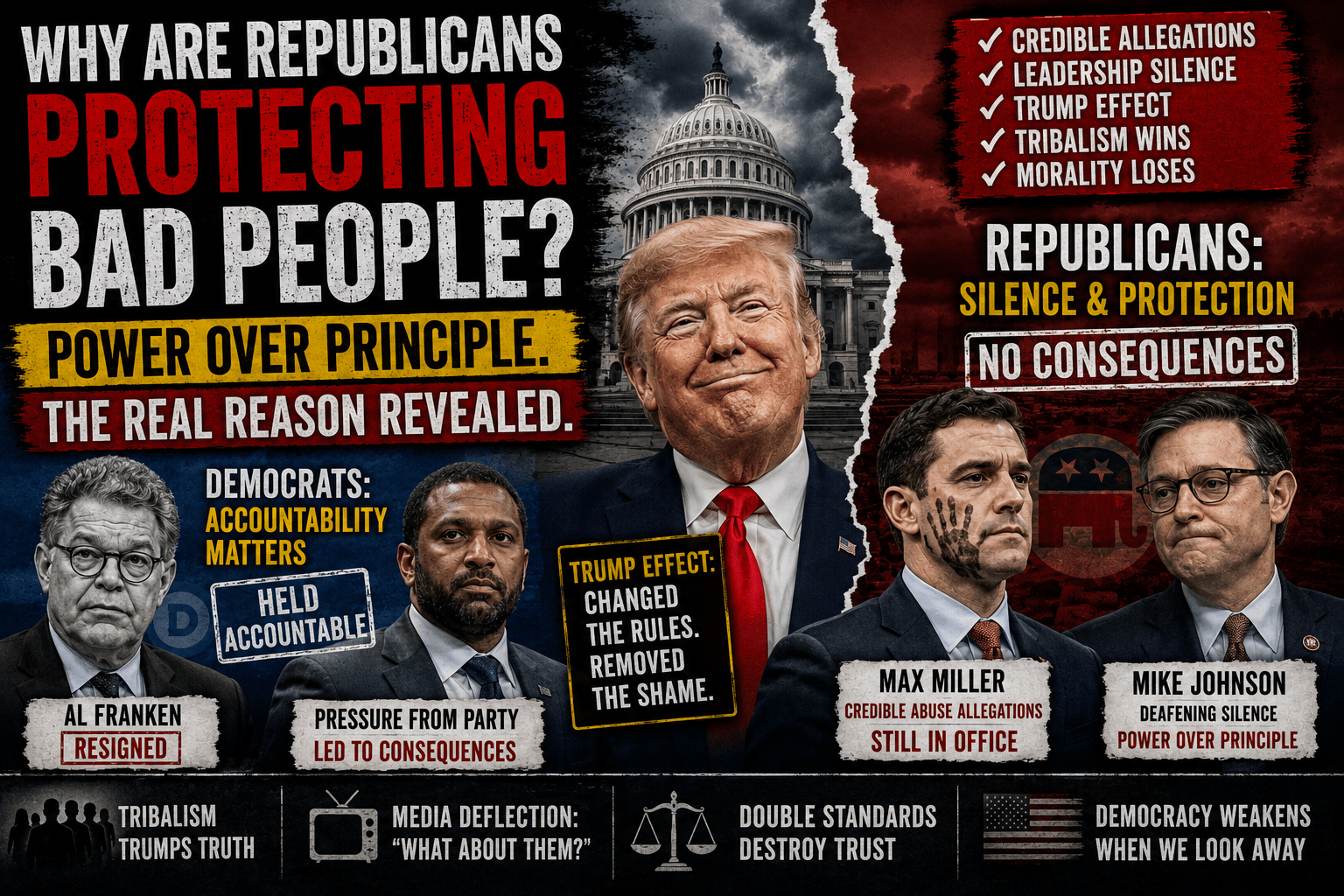
When a Democratic politician faces credible allegations of misconduct, there is typically a swift internal pressure campaign. The party base tends to demand moral purity, or at least a baseline of ethical behavior, and party leaders usually force the offending politician out. We saw this in the past with figures like Al Franken, and it continues today.
However, on the Republican side, the playbook has entirely changed. When a representative like Max Miller faces documented, credible allegations of abuse—even from prominent figures within his own party—the response from party leadership is deafening silence. There are no calls for resignation. There are no ethics investigations pushed by his own team.
Why is this happening? It comes down to two major factors: the math of political power, and a new “permission structure” created at the very top.
The Math of Morality: The House Majority
To understand why leadership turns a blind eye to bad behavior, you have to look at the numbers.
Currently, the balance of power in the House of Representatives is incredibly fragile. The Speaker of the House, Mike Johnson, is operating with a razor-thin majority. In a tightly divided government, every single seat is a matter of political life and death for the party’s agenda.
If Republican leadership were to suddenly decide that Max Miller—or any other representative with a rap sheet or credible allegations against them—needed to be expelled from Congress, they would be creating a vacancy. That vacancy leads to a special election, which introduces uncertainty. They could lose the seat.
For modern political leadership, holding onto power has eclipsed institutional integrity. The calculation is deeply cynical but highly practical: they would rather protect a deeply flawed, or even dangerous, individual who votes with the party line than risk losing a seat to the opposing party. Morality is no longer the baseline; it is treated as a liability that gets in the way of maintaining a majority.
The Trump Effect and the “Permission Structure”
You cannot explain this shift without looking at Donald Trump. He fundamentally rewired how the Republican party handles controversy.
Before Trump, the standard political reaction to a scandal was to apologize, lay low, or resign. Trump introduced a new strategy: deny, deflect, and aggressively attack the accusers.
We saw this explicitly in the E. Jean Carroll case. A jury found Trump liable for sexual abuse and defamation, ordering him to pay millions. In a previous era, this would have ended a presidential campaign immediately. Instead, Trump brushed it off, his supporters rallied around him, and the party establishment fell in line.
When the leader of the party survives and even thrives after facing severe, credible allegations and legal defeats, it creates what political scientists call a permission structure.
A permission structure is a psychological and social green light. It tells every other politician down the ballot: You don’t have to resign anymore. If you just refuse to show shame, if you attack the media, and if you claim it’s a political witch hunt, you can survive.
When a party’s presidential nominee openly deflects questions about abusers or suggests that accusers are just telling “big falsehoods,” it removes any pressure for lower-level politicians to be held accountable. The bar for acceptable behavior is lowered for everyone.
The Psychology of Political Tribalism
You might be asking: Why do the voters accept this? Why don’t regular citizens demand better from the people representing them?
The answer lies in a phenomenon called negative partisanship.
In modern American politics, voters are often driven less by how much they love their own party, and more by how much they absolutely despise the other side. Political media has convinced many voters that the opposing party isn’t just wrong on policy, but that they are an existential threat to the country.
When you believe the other side is out to destroy America, you will forgive almost anything your own side does.
If a voter believes that electing a Democrat means the destruction of their values, their economy, or their way of life, they will hold their nose and vote for a Republican accused of domestic abuse. They view it as a necessary evil. The politician’s personal crimes are seen as less dangerous than the opponent’s political policies.
This tribalism creates a shield for bad actors. Politicians realize that as long as they press the right cultural buttons and attack the right enemies, their base will defend them against any personal failing or legal trouble.
Deflection as a Strategy
When these politicians or their surrogates are forced onto television to answer for these double standards, they use a tactic called “whataboutism.”
If you ask a political surrogate about the E. Jean Carroll verdict or about a congressman’s history of abuse, they rarely defend the action itself. Instead, they pivot immediately. They will say, “Well, what about this Democrat? Why didn’t they speak up sooner?” or “What about the border?”
This is an intentional media strategy designed to exhaust the viewer. By constantly changing the subject and throwing mud back across the aisle, they make the average voter feel like everyone is corrupt, so nothing actually matters. If everyone is dirty, then nobody has to clean up their act.
The Long-Term Cost
The danger here goes far beyond one election cycle or one slim House majority.
When a political party decides that character, the rule of law, and basic human decency are secondary to winning, the institutions of democracy begin to erode. If there is no line a politician can cross that will cause their own side to reject them, then there are no rules at all.
Democracy relies on a shared baseline of reality and accountability. When we allow politicians to operate with impunity simply because they wear the right team colors, we are not just giving them a pass on bad behavior—we are giving away our own power as citizens.
How do you think we can rebuild a system where voters hold their own candidates accountable, rather than just pointing fingers at the other side?